
Ny statistik från Kollektivtrafikbarometern visar att sport och träning toppar listan över fritidsresor – men att bilen fortfarande dominerar. Bland 15–19-åringar görs hela 32 procent av fritidsresorna med kollektivtrafik.
Ny statistik från Kollektivtrafikbarometern kastar ljus över hur vi svenskar tar oss till träningen, kompisarna och naturen på fritiden – och visar tydligt att bilen fortfarande är det dominerande valet. Men rapporten pekar också på konkreta möjligheter att locka fler att hoppa på bussen eller tunnelbanan när vardagen väl är slut för dagen.
Fritidsresor – det tredje största kollektivtrafikändamålet
Kollektivtrafikbarometern är Svensk Kollektivtrafiks återkommande resvane- och attitydundersökning, som varje år samlar svar från nära 100 000 slumpmässigt utvalda personer. I årets temarapport, publicerad i juni 2026, står fritids- och besöksresor i fokus. Det visar sig att denna kategori utgör 22 procent av alla kollektivtrafikresor – en inte obetydlig andel, men ändå klart lägre än resor till arbete och studier (39 procent) samt inköp och service (26 procent).
Sport och träning är den allra vanligaste typen av fritidsresa, särskilt bland män. Socialt umgänge kommer på andra plats och är den dominerande kategorin bland kvinnor. Kvinnor gör sammantaget en något större andel fritidsresor med kollektivtrafik (24 procent) jämfört med män (21 procent).
Utan bil – nästan allt sker hållbart
En av de mest slående siffrorna i rapporten handlar om skillnaden mellan de som har tillgång till bil och de som inte har det. För den bilförare som saknar körkort eller tillgång till bil görs hela 87 procent av fritidsresorna till fots, med cykel eller med kollektivtrafik. Bland de som har bil hemma är motsvarande siffra bara 32 procent.
– Kollektivtrafiken spelar en viktig roll för att de som inte har körkort och bil ska kunna utöva sina fritidsintressen, säger Mattias Andersson, branschexpert på Svensk Kollektivtrafik.
Det är med andra ord en stor och sårbar grupp som är beroende av ett väl fungerande kollektivtrafiknät för att kunna leva ett aktivt fritidsliv – något som borde vara ett tungt argument i debatten om kvälls- och helgtrafik.
Växlarna – de som optimerar sitt resande
Rapporten delar in resenärerna i grupper beroende på hur de reser. De så kallade växlarna – personer som har tillgång till både bil och kollektivtrafik och väljer beroende på situation – visar sig ha den högsta andelen kollektivtrafikresor på fritiden, med 25 procent. De renodlade bilisterna ligger lägst på 19 procent. Det tyder på att växlarna aktivt väger in faktorer som restid och parkeringsbesväret när de väljer färdsätt, snarare än att per automatik ta bilen.
Det är just den gruppen som är mest intressant att nå ut till med bättre information och mer tillgänglig kollektivtrafik – och för oss cyklister i Stockholm är det en välbekant dynamik. Fler alternativ leder till klokare val.
Lördag är den stora kollektivtrafikdagen – och naturen den stora förloraren
Statistiken visar att fritidsresandet med kollektivtrafik är som störst på lördagar, då 37 procent av resorna sker, jämfört med bara 18 procent en vanlig tisdag. Fördelningen över årets månader är däremot relativt jämn.
En kategori sticker ut som särskilt svår att nå: resor till friluftsliv och natur. Där är andelen kollektivtrafikresor hela tio procentenheter lägre än andelen bilresor. Det är knappast förvånande, men det illustrerar att infrastrukturen utanför stadskärnan fortfarande haltar rejält.
Unga åker kollektivt – men fler behöver lockas
En ljuspunkt är ungdomarna. I åldersgruppen 15–19 år görs 32 procent av fritidsresorna med kollektivtrafik – klart högre än genomsnittet. Det visar att vanan att resa kollektivt på fritiden finns där, men att den riskerar att konkurreras ut när körkortet väl är taget.
Rapporten pekar på att många som valde bilen uppger brist på tillgänglig kollektivtrafik som skäl. Mattias Andersson lyfter fram att lösningen delvis handlar om att förbättra utbud och tidtabeller, men också om att förändra resenärernas mindset. Han ser särskild potential i att hitta nya kollektivtrafiklösningar för sport- och kulturaktiviteter, där många samlas på samma plats vid återkommande tillfällen – ett perfekt läge för samordnade transportlösningar.
Vad innebär det här för oss som cyklar?
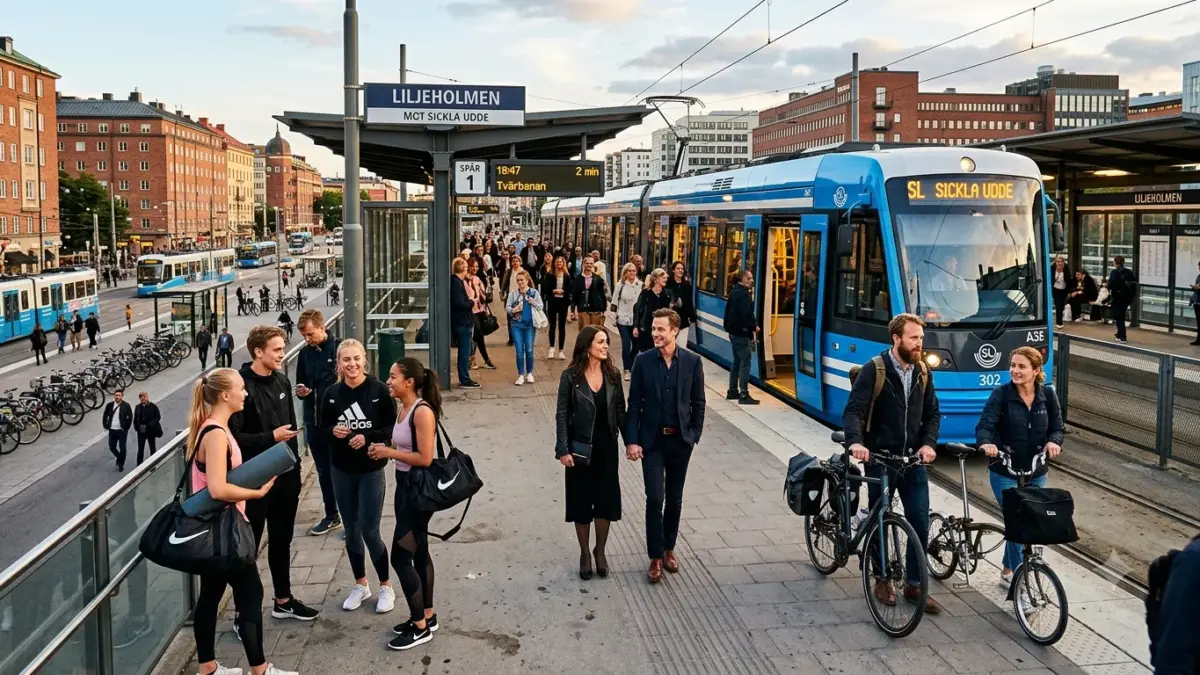
Cykel nämns genomgående som ett av de hållbara alternativen vid sidan av gång och kollektivtrafik. I en stad som Stockholm, där kombination av cykel och kollektivtrafik är ett naturligt sätt att ta sig runt, är det positivt att se att potentialen för ökat hållbart resande på fritiden är stor. Bättre kvälls- och helgtrafik gynnar inte bara kollektivtrafikresenärerna – det gynnar hela det hållbara transportsystemet.
New statistics from the Public Transport Barometer show that sports and exercise top the list of leisure trips – but the car still dominates. Among 15–19-year-olds, as many as 32 percent of leisure trips are made using public transport.
New statistics from the Public Transport Barometer shed light on how we Swedes get to training, friends, and nature in our free time – and clearly show that the car is still the dominant choice. But the report also points to concrete opportunities to attract more people to hop on the bus or subway once the workday is over.
Leisure trips – the third largest public transport purpose
The Public Transport Barometer is Swedish Public Transport’s recurring travel habits and attitude survey, which each year gathers responses from nearly 100,000 randomly selected people. In this year’s theme report, published in June 2026, leisure and visiting trips are in focus. It turns out that this category accounts for 22 percent of all public transport trips – a significant proportion, but still clearly lower than trips to work and studies (39 percent) and shopping and services (26 percent).
Sports and exercise are by far the most common type of leisure trip, particularly among men. Social activities come in second place and are the dominant category among women. Overall, women make a slightly larger share of leisure trips using public transport (24 percent) compared to men (21 percent).
Without a car – almost everything is sustainable
One of the most striking figures in the report concerns the difference between those who have access to a car and those who do not. For those without a driving license or access to a car, as many as 87 percent of leisure trips are made on foot, by bicycle, or by public transport. Among those who have a car at home, the corresponding figure is only 32 percent.
– Public transport plays an important role in enabling those without a driving license and access to a car to pursue their leisure interests, says Mattias Andersson, industry expert at Swedish Public Transport.
In other words, there is a large and vulnerable group that depends on a well-functioning public transport network to be able to live an active leisure life – something that should be a strong argument in the debate about evening and weekend services.
Switchers – those who optimize their travel
The report divides travelers into groups depending on how they travel. The so-called switchers – people who have access to both a car and public transport and choose depending on the situation – have the highest share of public transport trips for leisure, at 25 percent. The dedicated drivers score lowest at 19 percent. This suggests that switchers actively weigh factors such as travel time and parking difficulties when choosing a mode of transport, rather than automatically taking the car.
This group is the most interesting to reach with better information and more accessible public transport – and for us cyclists in Stockholm, it’s a familiar dynamic. More alternatives lead to smarter choices.
Saturday is the big public transport day – and nature the big loser
The statistics show that leisure travel by public transport is greatest on Saturdays, when 37 percent of trips are made, compared to just 18 percent on an ordinary Tuesday. The distribution across the months of the year is, however, relatively even.
One category stands out as particularly difficult to reach: trips to outdoor recreation and nature. Here, the share of public transport trips is a full ten percentage points lower than the share of car trips. This is hardly surprising, but it illustrates that infrastructure outside the city center still lags considerably.
Young people use public transport – but more need to be attracted
A bright spot is young people. In the 15–19 age group, 32 percent of leisure trips are made using public transport – clearly higher than the average. This shows that the habit of traveling by public transport during leisure time exists among them, but risks being crowded out once they get their driver’s license.
The report notes that many who chose the car cite lack of available public transport as the reason. Mattias Andersson highlights that the solution partly involves improving supply and schedules, but also changing travelers’ mindset. He sees particular potential in finding new public transport solutions for sports and cultural activities, where many gather in the same place at recurring occasions – a perfect setup for coordinated transport solutions.
What does this mean for us cyclists?
The bicycle is mentioned throughout as one of the sustainable alternatives alongside walking and public transport. In a city like Stockholm, where the combination of bicycle and public transport is a natural way to get around, it is positive to see that the potential for increased sustainable leisure travel is great. Better evening and weekend services benefit not only public transport users – it benefits the entire sustainable transport system.